 Antigua Guatemala City Guide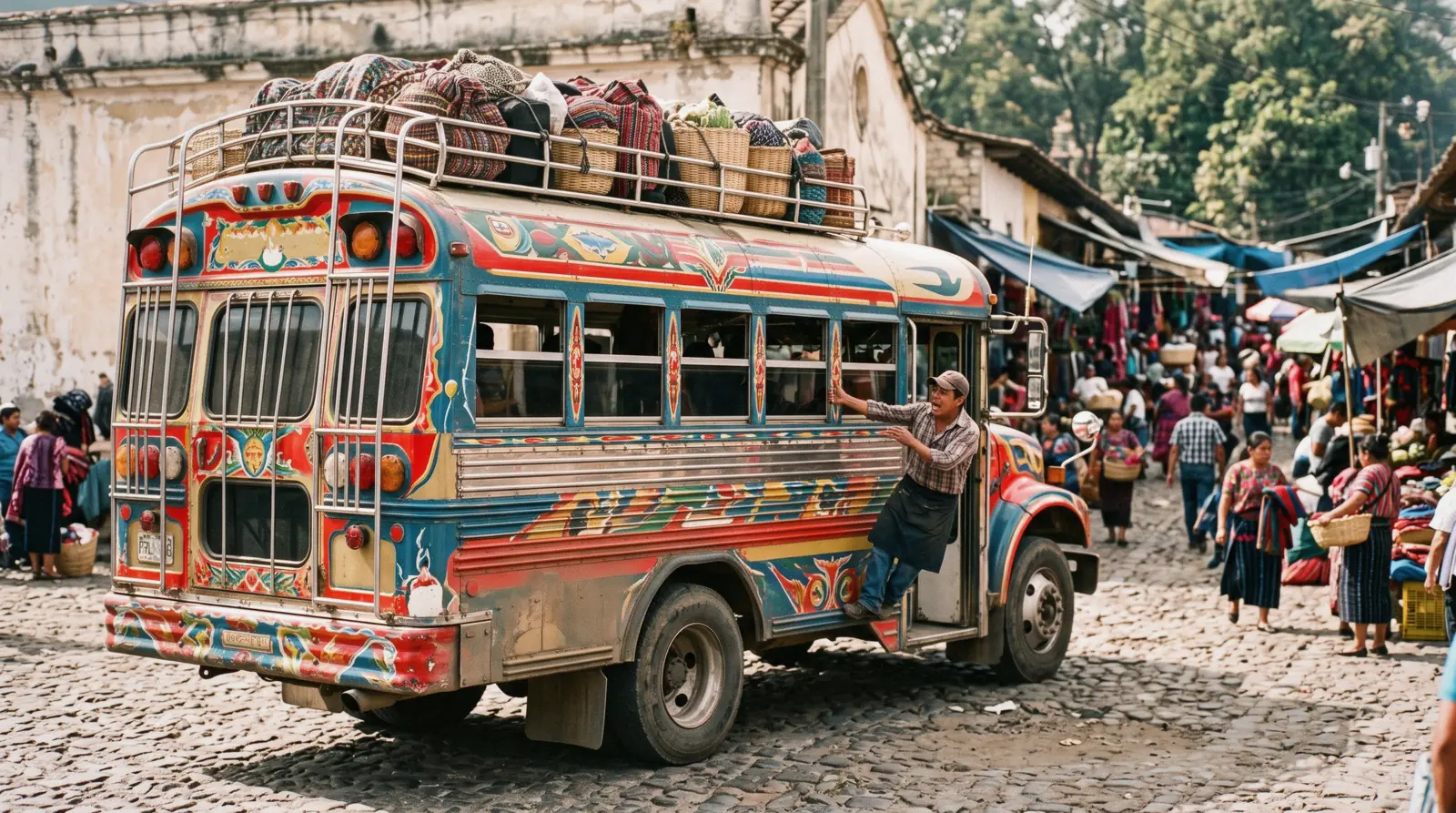
Chicken Buses in Guatemala: Routes, Fares and the Truth
Every chicken bus Guatemala puts on the road is a camioneta, a retired US school bus repainted, rebuilt and run as private public transport on fixed routes for cash fares. The name is the common explanation for the livestock that used to ride along with the passengers, printed here as lore rather than official history. This page does the practical job for Antigua: exactly where the buses leave from (the lot behind El Mercado, with the Guatemala City buses on the next street south of the artisan market), what they cost, and what they do not cost. Only one fare on the network is sourced anywhere official: Q15 ($1.96) cash to Guatemala City. Village and in-town fares are published nowhere official, and this page prints that gap honestly rather than inventing a tariff. It also quotes the UK FCDO advisory in full, because the official advice on these buses matters. For the rest of your transport plan, see the Antigua Guatemala city guide and getting around.
Quick answer Where the buses leave, the one sourced fare, and the advisory quoted in full
A chicken bus in Guatemala is a repainted US school bus running a fixed route for local fares, crewed by a driver and a helper called the ayudante. In Antigua they leave from the lot behind El Mercado on the town's west side, with the Guatemala City buses on the next street south of the artisan market. The one sourced fare is Q15 ($1.96) cash to the capital. Village hops to places like San Antonio Aguas Calientes or Ciudad Vieja are commonly reported at Q1-Q5, but no official tariff exists, so you pay what the ayudante asks. The FCDO advises against public buses outright, citing poor maintenance, overcrowding and frequent accidents. That makes a village ride in daylight a calculated choice, and the capital run with luggage the tourist shuttle's job at $15.00 (Q115).
Key takeaways
- Start at the terminal and the corners, then pin your spots on the bus map.
- Know the fare picture before you board: fares and paying.
- Read what the advisories say, quoted in full from the FCDO.
- For the capital and the airport, compare the capital run with the shuttle on the airport page.
Chicken Bus or Shuttle, Compared
This table compares the two ways visitors actually ride out of Antigua: the public camioneta and the tourist shuttle. The Q15 fare to the capital comes from a published route guide, the shuttle price comes from the operator's own page, and the advisory wording comes from the UK FCDO. What is not in the table: an official village-fare tariff does not exist, and there are no sourced journey times beyond the shuttle's published schedule.
| Option | Fare | Baggage reality | What the advisory says | Best for |
|---|---|---|---|---|
| Chicken bus to a village (San Antonio Aguas Calientes, Ciudad Vieja, Santa María de Jesús) | Q1-Q5 commonly reported, no official tariff | Rack or aisle. The ayudante stacks it | FCDO: avoid public buses, poorly maintained, overcrowded, accidents common and sometimes fatal | The classic short ride in daylight with a daypack |
| Chicken bus to Guatemala City | Q15 ($1.96), cash | Rack, aisle or roof ladder | Same warning, plus armed attacks or robberies on most tourist routes between Guatemala City and Antigua | Travellers with time, no luggage and local experience |
| Tourist shuttle to Guatemala City / the airport | $15.00 (Q115), 6 departures daily | Underfloor hold | Private services are generally safer, though not immune (FCDO) | Airport runs, luggage, early starts (04:00 first departure) |
| Tuk-tuk for the last mile in town | Municipal tariff Q10 ($1.31), agree first | Small bags only | In-town framing: radio-dispatched taxis, Uber where available, hotel taxis are the safer picks | Getting from the terminal lot to your room |
The decision this table makes is that the village hop in daylight is the ride the buses do best, and the capital-and-luggage combination belongs to the shuttle. Figures current for in Q3 2026.
What a Chicken Bus Is (and Why the Name)
In Guatemala the buses locals call chicken buses are camionetas, retired US school buses sold north, driven south and rebuilt into working public transport. The UK FCDO's own phrase, "repainted US school buses", is the official description and it is accurate. A retired American school bus arrives in Guatemala, gets a new paint job in loud colours, often a new name across the windshield, and sometimes chrome, lights and a sound system.
Inside, seats are reinstalled tight, a luggage rack runs the full length above the windows, and a metal ladder at the back reaches the roof rack for the big bags. The crew is two people: the driver and the ayudante, the young helper who hangs from the doorway, shouts the destination, pulls passengers aboard, collects fares and makes change from a fistful of coins. The name is the common explanation, not an official story: livestock, chickens included, historically rode along with the passengers, and the buses pack people in as tight as a coop.
Treat it as lore. A ride works simply. On the route out of town you flag the bus down or board at the lot, the ayudante collects as the bus moves, money passes hand to hand down the aisle to him, and you shout your stop or he remembers you asked.
In Antigua the village buses' routes are not fixed through town, which means there is no single stop where all of them pass. You find them at the corners where they do gather, or you wait on their road out of town and flag one. Everyone rides them: school kids in uniform, market women with bundles, workers, travellers.
That means crowding peaks with school and work hours. The honest service note from the advisory cuts both ways. These buses are cheap and constant precisely because they are informal, running on published tariffs nowhere and timetables nowhere, filling a role no formal company fills.
Timing shapes the ride as much as the route does. The buses are fullest at school and work peaks, and thinnest mid-morning and mid-afternoon, which is exactly when a first-time rider should go. Stand at the corner a few minutes before the hour and watch the pattern: a bus slows, the ayudante scans the pavement, and a raised arm or a step toward the kerb is all the signal he needs.
Market days load the village runs with bundles and baskets, which is part of the experience and part of the crowding. If a bus looks fuller than you fancy, let it go, because on the Antigua routes another follows within minutes on the frequent runs and within the half hour on the quiet ones.
Where the Buses Leave From in Antigua
Antigua has one central bus stop, called La Terminal, plus a separate street for the capital run and a pair of village-bus corners. Learn the three and you can go anywhere the buses go.
La Terminal, behind the market
The central bus stop is the lot behind El Mercado, the central market, on the west side of town north-west of the intersection of 4a Calle Poniente and Alameda Santa Lucía. From that lot the buses fan out to Chimaltenango, Escuintla, Santa María de Jesús, San Miguel Dueñas, Ciudad Vieja, San Antonio Aguas Calientes and anywhere around. Holding a seat is easy: board, sit, and the bus leaves when it is full enough, which on busy routes is fast.
Once you arrive, the walk from the lot into the street grid is minutes, since the terminal sits right at the grid's west edge behind the market. With bags, a tuk-tuk is the easy last mile at the municipal Q10 ($1.31) tariff, but agree the fare before you get in, and note tuk-tuks stop around 22:00. See getting around for the in-town options, and the market next door for what to do before or after the ride.
| Destination | Leaves from | Frequency | Sourced fare |
|---|---|---|---|
| Guatemala City (and San Miguel Dueñas, Ciudad Vieja) | Next street south of the artisan market | From ~05:30, every 4-5 minutes | Q15 ($1.96) to the capital |
| Chimaltenango (also for Jocotenango) | La Terminal lot, behind El Mercado | Frequent through the day | Not stated officially |
| San Antonio Aguas Calientes / Santa María de Jesús | La Terminal lot | Every 10-20 minutes | Not stated officially |
| Escuintla | La Terminal lot | Frequent through the day | Not stated officially |
| San Pedro / San Juan / Santa Ana village runs | Mercado or Iglesia de Santa Lucía corners | Every 10-20 minutes | Not stated officially |
The village corners
The village buses to San Pedro, San Juan and Santa Ana run every 10 to 20 minutes, but you will not find them from one fixed stop, because their routes are not fixed through town. The honest answer is to look at the Mercado or the Iglesia de Santa Lucía, the two places these buses reliably gather. For Jocotenango there is a trick that always works: take any northbound Chimaltenango bus, all of which pass through that northern suburb.
Once you are on the way out of town, flag-down culture takes over. Stand on the route road, raise an arm when the bus appears, and the ayudante will wave it to the kerb. The same works for hopping between villages on the roads around Antigua.
Finding your bus without reading Spanish
Every bus carries a destination card in the windshield, and the ayudante shouts the destination out the door as the bus slows. Between the two you rarely need Spanish. If you are still unsure, say the name of your destination to the driver before boarding and wait for a nod.
Board the wrong bus and you will find out within minutes, since the ayudante asks everyone anyway. Keep small notes and coins on you, because a Q50 note on a village run is a problem for everyone in the aisle.
The Bus Map: The Terminal and the Corners
The three places a rider actually stands, pinned from the published route description (Wikivoyage's, via the facts pack). Pin positions are approximate street-geometry placements.
Pins are placed from the published intersection and street descriptions, not exact addresses. Stand on the block and look for the buses.
Fares and Paying: The One Sourced Number
Here is the whole sourced fare picture on the public-bus side of this page: Q15 ($1.96) cash to Guatemala City. That is it. That is the one number published on any source this page can cite, and everything else is a gap this guide would rather print than fill with invention.
The negative finding is the centrepiece. Village and in-town fares on the routes around Antigua are stated nowhere official. The municipality's site, the travel guides, the news: none publish a tariff.
What happens instead is that fares are posted informally on the vehicles themselves. The commonly reported convention is a Q1-Q5 zone for village hops, where Q1 = $0.13 and Q5 = $0.65, but no citable official tariff exists behind it. Practically, that means you pay what the ayudante asks, keep coins ready, and treat a fare a local confirms to you as the working tariff.
If the number you are handed is wildly above what a local pays, say where you are going again and hold out the coins. It is cash only, always. No card reader has ever been fitted to a camioneta and none is coming.
The money-safety frame around this comes from the FCDO: carry only small amounts of cash and avoid withdrawing a lot of money, particularly at night. Worth knowing if you are topping up coins for bus fares: ATMs in Antigua carry fixed fees commonly reported at Q40-Q49 ($5.24-$6.41) per withdrawal, so taking one larger amount beats several small ones. See the money page for the full picture.
Be clear about what the fare buys and what it does not. It buys a seat-or-standing spot on a bus going your way. It buys no luggage ticket, no timetable, and no seat guarantee.
If you need any of those three, that is what the shuttle column of this page is for.
The Guatemala City Run: Q15 and a Decision
The capital run is the most useful and the most demanding chicken bus route out of Antigua. On the Antigua side the buses leave from the next street south of the artisan market, just south of the main terminal lot, and they honk and fill from about 05:30, departing every 4 to 5 minutes. The shout you will hear is "Guate!
Guate!". On the capital side, pickups work the other way round: the buses to Antigua stop at the El Trebol intersection in Zona 8 and also under the pedestrian bridge at the Tikal Futura mall on Calzada Roosevelt. The fare is Q15 ($1.96), cash only, and the Antigua-side drop-off is near the Mercado, the central market, which puts you minutes from the grid.
One thing this bus does not do: the airport. There is no direct public bus from La Aurora to Antigua, and the chicken bus does not serve the airport at all. For the airport leg you need a shuttle, taxi or ride-hail, all laid out on the airport page.
The alternative for the capital itself is the tourist shuttle: $15.00 (Q115) with six daily departures from Antigua at 04:00, 07:00, 09:00, 12:30, 15:00 and 19:00, a journey of about 2 h 15, booked with 48 hours notice. So when is the Q15 ($1.96) worth it? When you have time, no luggage beyond a daypack, daylight on your side, and you want the local experience.
When is the shuttle the only sane answer? Luggage, night arrivals, and any airport connection. For the return trip, remember the Antigua-side departure corner is the street south of the artisan market, and the buses stop at Trebol and Tikal Futura going back into the capital.
Safety: What the Advisory Says, In Full
The UK FCDO advisory on Guatemala's public buses says this, verbatim: "Avoid travelling on public buses (repainted US school buses). There have been incidents of attacks and extortion by local gangs on bus drivers.. These buses are usually poorly maintained, overcrowded and do not generally adhere to the rules of the road..
Accidents are common and sometimes fatal. Private intercity coach services are generally safer, but gangs have also targeted these." On the routes visitors actually use, the FCDO adds: "There have been armed attacks or robberies on most tourist routes between Guatemala City, Antigua, Tikal, Petén and Lake Atitlán." That is the official position, quoted in full, and this page will not soften it. Here is the frame around the quote.
If you decide to ride, the calculus that works is short village hops in daylight, with a daypack rather than a suitcase, seated mid-bus rather than by a door, phone stowed and nothing valuable hanging on the rack. Crowded peaks carry more pickpocket risk, so bags go on your lap. Know the safety net before you board.
Police answer 110, fire and ambulance answer 122 or 123. Guatemala's tourist-assistance program ASISTUR runs a 24/7 line in English and Spanish on 1500, and Antigua has its own tourist police, DISETUR, in addition to the regular force. The US advisory for Guatemala is Level 3, Reconsider Travel, country-wide, and Antigua sits in no restricted zone.
The honest conclusion: the FCDO warning is a country-wide warning about public buses generally, not a map of this route on this afternoon, and Guatemalans ride these buses by the millions of trips around that warning every day. But the decision is yours, and this page's decision line stays where the evidence points: villages in daylight, capital by shuttle. More on the context in safety.
Riding One Well: Dos and Don'ts
Do
- Ride the village hops in daylight, with a daypack rather than a suitcase.
- Have coins ready. Village fares run roughly Q1-Q5 and there is no official tariff, so the ayudante needs exact change more than you do.
- Confirm the destination with the driver or the ayudante before boarding, and get a nod.
- Keep the phone stowed and bags on your lap, seated mid-bus away from the doors.
- Save ASISTUR's 1500 line and the police 110 number in your phone before you ride.
Don't
- Do not take the capital run with big luggage or at night. That is the $15.00 (Q115) shuttle's job.
- Do not expect a card reader or a timetable. It is cash in the hand and the bus leaves when it is full.
- Do not hang bags on the outside rack in a dense crowd where you cannot watch them.
- Do not build an airport plan around the bus. There is no airport service.
- Do not wave your phone around by the window while riding.
When the Bus Is Not the Answer
Four bookable runs for the days the buses lose, the airport, the early start, the lake and the volcano road, prices and ratings are the platform's own.
 from $24
Guatemala City: One way Shared Transfer to Antigua
Shared van between Guatemala City and Antigua; the budget door-to-door with luggage space.
Check Availability from $25
Antigua Guatemala: One-Way Shared Van Transfer to Panajachel
Direct shared van Antigua to Panajachel, the gateway town for Lake Atitlan; three hours, no changes.
Check Availability from $92
Lake Atitlan One Day Tour from Antigua
Shared day tour to three Atitlan villages with boat crossings; the classic lake day from Antigua.
Check Availability from $23
From Antigua: Pacaya Volcano Tour in English/Spanish
Half-day guided Pacaya hike with hotel pickup and marshmallows over the steam vents; the classic introduction to an active volcano, run in English or Spanish.
Check AvailabilityPrices, ratings and details are the platform's own. dollar figures are the listed prices — the platform bills in your account's currency.
Next
Getting around
Tuk-tuk tariffs, shuttles and walking in town
The airport page
Why the buses do not serve La Aurora, and what does
The market
Next door to the terminal lot, and the town's food engine
Safety
The advisories and the emergency numbers in one place
Chicken Buses in Guatemala: Questions
Why are they called chicken buses in Guatemala?
The common explanation is the one everyone tells: livestock, chickens included, used to ride along with the passengers on these buses, and the buses themselves pack people in as tight as a coop. That is lore, not an official history, and no transport authority has ever published an origin story. What is official is the description of what they are. The UK FCDO calls them "repainted US school buses", which is exactly what they are: retired American school buses rebuilt with racks, loud paint and a driver-plus-helper crew. The name, the paint and the chickens all live in the what-is guide on this page.
What are chicken buses in Guatemala?
They are camionetas, retired US school buses run privately as public transport on fixed routes for cash fares. Each bus has a two-person crew, a driver and an ayudante, the helper who shouts the destination, collects fares hand to hand down the aisle and makes change from a pocketful of coins. There are no timetables and no card readers. The bus leaves when it is full enough. In Antigua the main hub is the lot behind El Mercado, the central market on the town's west side, with the full breakdown of routes and corners at the terminal and the corners.
Are chicken buses in Guatemala safe?
The FCDO advises avoiding them, in its own words: the buses are "usually poorly maintained, overcrowded and do not generally adhere to the rules of the road", accidents are "common and sometimes fatal", and gangs have attacked and extorted drivers. The FCDO also notes "armed attacks or robberies on most tourist routes between Guatemala City, Antigua, Tikal, Petén and Lake Atitlán", and that private shuttles are generally safer though not immune. The practical frame many riders use: village hops in daylight, daypack only, mid-bus seats, phone stowed. The net behind you is DISETUR tourist police in Antigua and ASISTUR on 1500, 24/7 in English and Spanish. The full advisory sits at what the advisories say.
How much is the chicken bus from Guatemala City to Antigua?
Q15 ($1.96), cash only, and it is the one fare on the whole network with a citable source. Pickups on the capital side are at the El Trebol intersection in Zona 8 and under the pedestrian bridge at the Tikal Futura mall on Calzada Roosevelt. The drop-off in Antigua is near the Mercado, the central market. There is no airport service on this route. The alternative is the tourist shuttle at $15.00 (Q115), six departures daily including a 04:00, about 2 h 15, booked 48 hours ahead. The full comparison is at the capital run. Carry the fare in small notes, because a large denomination on a full bus slows the whole aisle and marks you out.
Where does the chicken bus leave in Antigua?
Three places, depending on where you are going. The main terminal, La Terminal, is the lot behind El Mercado on the west side of town, north-west of the intersection of 4a Calle Poniente and Alameda Santa Lucía. It serves Chimaltenango, Escuintla, Santa María de Jesús, San Antonio Aguas Calientes and more. The Guatemala City buses, plus San Miguel Dueñas and Ciudad Vieja, leave from the next street south of the artisan market instead. The village runs to San Pedro, San Juan and Santa Ana gather at the Mercado and the Iglesia de Santa Lucía. All three are pinned on the bus map.
Can you take a chicken bus from the Guatemala City airport?
No. There is no direct public bus of any kind from La Aurora airport to Antigua, and the chicken buses do not serve the airport. The capital route starts inside the city, with pickups at El Trebol in Zona 8 and at Tikal Futura on Calzada Roosevelt, neither of which is walkable from the airport with bags. The airport leg needs a shared shuttle, an authorized taxi, a private transfer or ride-hail, all costed on the airport page. If you want the chicken bus experience, take a shuttle to Antigua first and ride the village buses from the terminal lot.
Chicken Buses on Film
Three films that show the buses as they are, the rides, the rebuilds and the culture.
FIVE CHICKEN BUSES IN ONE DAY (Riding the chicken bus in Guatemala)
A full day riding the routes, the practical version of everything this page describes.
Video: Izzie and DaleOld School Buses Get A Makeover In Guatemala
How a retired US school bus becomes a camioneta, from paint to aisles.
Video: AJ+Inside Guatemala's Pimped Out Chicken Buses: Epic bus conversions and dangerous driving
The rebuild culture and the driving that earned the advisory's wording.
Video: Outlawes filmsVideos load from YouTube only when you press play.
We may earn a commission if you book through one of our links, at no extra cost to you. Full affiliate disclosure