 Antigua Guatemala City Guide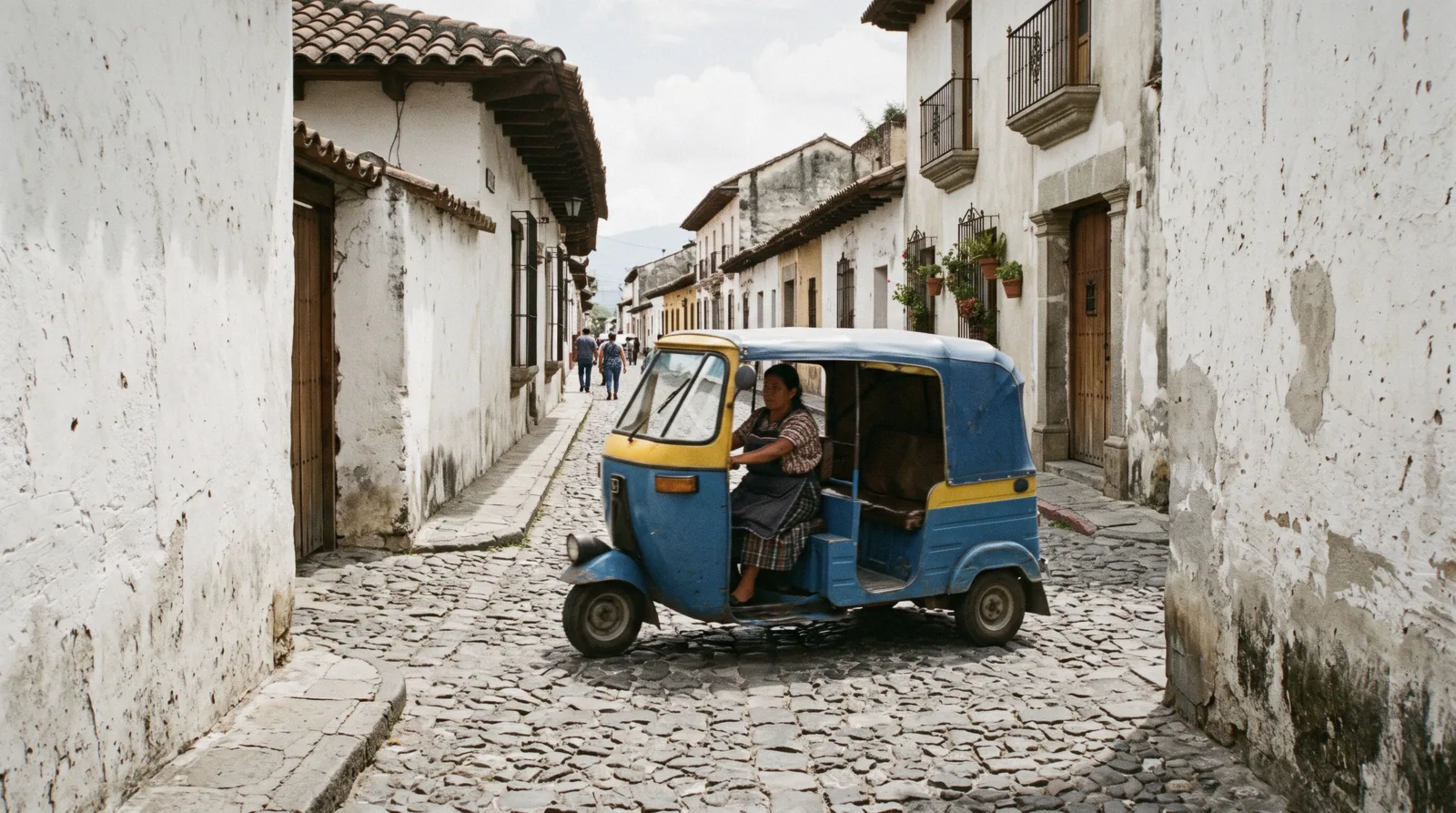
Getting Around Antigua Guatemala: Tuk-Tuks, Shuttles, Feet
Getting around Antigua Guatemala comes down to three decisions. Walk the flat UNESCO colonial grid, because almost everything is minutes from Parque Central. Take a tuk-tuk for the last mile, with the municipal tariff of Q10 ($1.31) in mind and the fare agreed before you board. Book a tourist shuttle for every long run, because this small city is Guatemala's main shuttle hub and the vans leave daily for the lake, the capital and the north. This page prices all of it honestly, from the municipality's own tariff announcement to each operator's published rate. Start with the Antigua Guatemala city guide for the city itself, and the airport page if La Aurora is where your trip begins.
Quick answer Walk the grid, agree the tuk-tuk fare, and book the shuttle hub
The grid makes walking the default. Antigua's UNESCO-listed colonial center is flat and compact, Parque Central is the measuring point, and most hotel-and-sight pairs are minutes apart. Tuk-tuks cover the last mile for the municipal tariff of Q10 ($1.31) per ride. They are not metered, so agree the fare before boarding, and they thin out from the street after about 22:00. Out of town, Antigua is Guatemala's shuttle hub, with Adrenalina alone running daily vans from $15.00 (Q115) to the capital and $25.00 (Q191) to Panajachel if you reserve 48 hours ahead. Chicken buses cover the village runs cheaply from the terminal behind El Mercado, and the FCDO advises against them for anything longer.
Key takeaways
- The full walking map with honest estimates of minutes from each stay area: walking the grid
- The official fare, the practice and the exact way to agree it: tuk-tuks
- Every out-of-town run compared, shared and private, with times: the shuttle hub
- The first run of every trip, priced every way: Guatemala City airport to Antigua
Every Way of Moving, Compared
The five ways of moving in and around the city sit side by side below: your own feet, tuk-tuks, taxis and ride-hail, tourist shuttles and chicken buses. The figures come from the municipality's own tariff announcement for tuk-tuks, the operators' published pages for shuttle prices, the route-guide fare for the capital bus, and the UK FCDO for the safety framing. Note what does not exist: an official in-town taxi or tuk-tuk meter, and any published tariff beyond the municipal Q10 ($1.31).
| Way | What it costs | When it wins | The catch |
|---|---|---|---|
| Walking | Free | Almost every pair of points inside the UNESCO grid | Cobblestones and strong altitude sun. Grip shoes and a hat |
| Tuk-tuk | Q10 ($1.31) municipal tariff, agreed before boarding | The last mile with bags, heat or a hill (San Felipe, El Hato road) | Not metered, drivers ask visitors more, usually no Guatemala City runs, stops around 22:00 |
| Radio-dispatched taxi / Uber / hotel taxi | No published tariff | Airport runs, night moves, rain | FCDO frames these as the safer picks. Agree or check the fare in the app |
| Tourist shuttle | $15.00 (Q115) to the capital, $25.00 (Q191) to Panajachel, published rates | Every long run out of town, luggage included | 48 h notice at Adrenalina. Door-to-door means center hotels only |
| Chicken bus | Q15 ($1.96) to the capital. Village fares not officially stated | Village hops in daylight with a daypack | The FCDO advises against public buses: poorly maintained, overcrowded, accidents common and sometimes fatal |
Inside the grid the feet win, and the tuk-tuk is a priced convenience rather than a necessity. Out of the grid, the shuttle hub takes over.
Walking the Grid: The Default Way
Antigua's UNESCO-listed colonial grid is flat, compact and built for walking, which is why the feet win almost every comparison on this page. The whole plan is measured from Parque Central, the plaza at the center of the grid. Rooms inside the Centro blocks sit an estimated 0 to 5 minutes from the park.
The quiet band along 5a and 6a Avenida Sur and Alameda Santa Lucía, where many of the monastic conversions and quiet hotels stand, runs an estimated 8 to 15 minutes away. Jocotenango, the adjacent town that holds Finca La Azotea and its museums, is an estimated 25 to 35 minutes on foot, or a short tuk-tuk. Treat all of these as street-geometry estimates rather than stopwatch measurements.
What the walking actually feels like depends on two things. First, the cobblestones: they are part of the UNESCO character and they reward grip-soled shoes over smooth soles. Second, the altitude.
At about 1,530 m the midday sun is stronger than the temperature suggests, so a hat and water matter more than a jacket does before dark. After dark the equation changes. The safety page carries the full advice, and the practical movement note is that tuk-tuks thin out from the street around 22:00, so late returns end on foot or at the hotel desk.
A light layer helps, because nights in the 50s Fahrenheit are normal year-round. Three anchors make navigating simple. The market and the bus terminal sit on the grid's west edge, a straight walk out 4a Calle Poniente.
The Santa Catalina Arch frames the classic east-west route along 5a Avenida Norte, the street every visitor walks at least twice. And 4a Calle Oriente runs east toward the municipal palace and the arches of the Ayuntamiento. For routed walks with sights in order, see the walks page.
For the full pin set, the map page has everything plotted. If you choose a hotel by minutes to the park rather than by name, the whole city opens up on foot.
Tuk-Tuks: The Q10 Tariff and the Practice
The official tariff
The Municipalidad de La Antigua Guatemala set the moto-taxi fare at Q10 ($1.31) per ride within the city, announced on the municipality's own channel. Tuk-tuks are not metered, the fare is per ride, and it is a cash fare. That is the whole official layer, and it is the number to carry in your head when the negotiating starts.
The practice, and how to pay it
The practice runs higher than the tariff. Drivers commonly ask visitors Q15 or more, and without a negotiated fare they can charge 50 to 100 percent above the Q10 ($1.31) official rate. The fix is a two-sentence script: name the destination, agree the price, then get in.
It is not rudeness, it is the market, and a polite agreement at the kerb beats an argument at the destination. You find tuk-tuks by flagging one down in the street or at the taxi queue at Parque Central. Know the limits as well as the price: they usually do not run to Guatemala City, they come off the street around 22:00, and the cabin takes small bags rather than suitcases.
Inside the grid, ask yourself one question before flagging one: is this ride longer than ten minutes on foot? On most pairs of points in the center, the honest answer is no, and the walk wins.
| Fact | What it means for you |
|---|---|
| Municipal tariff: Q10 ($1.31) per in-city ride | The number to name when you agree the fare |
| Not metered, cash only | Agree before boarding, have the exact change |
| Practice: Q15+ quoted to visitors, up to 50-100% over | The negotiation is the norm, not rudeness |
| Stops around 22:00 | Late nights end on foot or at the hotel desk |
| Usually no Guatemala City runs | The capital belongs to shuttle, taxi or bus |
Taxis and Uber: The Official Frame
The UK FCDO frames safer in-town transport plainly: radio-dispatched taxis, which in Antigua are usually yellow, Uber where it is available, and taxis arranged through your hotel. Those three channels are the official advice, and they cover the moments when wheels beat feet. The honest gap is pricing.
There is no official published taxi tariff in Antigua, for regular taxis or for hotel cars. That means the airport-page rules apply in town too: agree the fare before the trip starts, or let the app set it. Ask your hotel desk what a run should cost before you accept a car they call, and confirm the number with the driver.
Uber operates in Guatemala and works where drivers are online, with the fare fixed in the app and no negotiation at the curb. When does each win? Night, rain and luggage are the tuk-tuk's weak points and a taxi's strengths.
The airport with an early flight is the clearest case of all, because tuk-tuks do not make the run and pre-dawn departures need a booked car. For that run priced every way, see the airport page. Keep a record of every ride, and keep the emergency numbers saved before any trip: police 110, and the ASISTUR tourist line 1500, which answers around the clock in English and Spanish.
If anything goes wrong in a taxi, those are the numbers that matter.
The Shuttle Hub: Every Long Run, Prices Compared
Antigua as the hub
Antigua is Guatemala's main shuttle hub. Adrenalina alone lists daily departures to Panajachel, San Pedro La Laguna, Guatemala City and the GUA airport, Coban, Lanquin, Rio Dulce, Huehuetenango, Flores, Chichicastenango, Monterrico and El Paredon. The booking rhythm matters as much as the map: shuttles must be reserved 48 hours ahead, by the operator's site or by phone on +502 5308 5106.
And read door-to-door carefully, because it means center hotels only, not the edge-of-town addresses.
| Run (Adrenalina, shared) | Price per person | Daily departures | Time |
|---|---|---|---|
| Antigua to Guatemala City / GUA airport | $15.00 (Q115) | 04:00, 07:00, 09:00, 12:30, 15:00, 19:00 | ~2 h 15 |
| Antigua to Panajachel (door-to-door, center hotels) | $25.00 (Q191) | 08:00, 12:30, 16:00 | ~3 h |
| Antigua to San Pedro La Laguna | $25.00 (Q191) | 08:30, 14:00 | ~4 h |
The private option
Turansa publishes private shuttle rates per trip, which is a different arithmetic: the van is yours, so groups split it. The airport run is $50.00 (Q382) for 1 to 4 passengers at any time, with a $15 surcharge after 21:00. Panajachel is $150 (Q1,146) per trip for up to 10 passengers, Chichicastenango $160, Monterrico $180 and the Copan border run $300.
The fine print is seasonal and explicit: the rates are not valid during Holy Week, August or New Year's Eve. The private van beats four shared seats when the group is real, the clock is awkward or the destination sits outside the shared timetable. For where those runs actually go, day trips ranks and routes them.
| Run (Turansa, private, per trip) | Price | Capacity |
|---|---|---|
| Antigua / GUA airport / Antigua | $50.00 (Q382), +$15 after 21:00 | 1-4 passengers |
| Antigua to Panajachel | $150 (Q1,146) | 1-10 passengers |
| Antigua to Chichicastenango | $160 | Per trip |
| Antigua to Monterrico | $180 | Per trip |
| Antigua to Copan (border run) | $300 | Per trip |
Who you can actually book
The honest operator note belongs on the page, because booking platforms come and go. GuateGo is a live booking platform whose prices load in JavaScript, with no static published tariff this guide can print. Atitrans' domain is parked and for sale.
Rainbow Travel has no reachable own site. That leaves the two operator pages above as the citable ones, and everything else in the market as unverified by this guide. Figures on this page are current for in Q3 2026.
Chicken Buses: The Village Network
Chicken buses, the repainted US school buses, are Guatemala's everyday transport, and in Antigua they earn their keep on short village hops. The full route-by-route detail lives on the chicken buses page, but the movement facts belong here. The terminal, known as La Terminal, is the lot behind El Mercado on the town's west side, north-west of the crossing of 4a Calle Poniente and Alameda Santa Lucía.
From it run buses to Chimaltenango, Escuintla, Santa María de Jesús, San Miguel Dueñas, Ciudad Vieja and San Antonio Aguas Calientes, among others. The village runs to San Pedro, San Juan and Santa Ana deserve a special note: they do not follow fixed routes through town. The reliable way to catch one is at the Mercado itself or at the Iglesia de Santa Lucía, where they gather.
They run roughly every 10 to 20 minutes through the day. Fares for these village hops are not officially published. The one sourced fare is the capital run: Guatemala City buses leave from the next street south of the artisan market, start honking from about 05:30, and depart every 4 to 5 minutes at Q15 ($1.96) cash.
Now the advisory, in short. The UK FCDO advises against travel on public buses: they are usually poorly maintained and overcrowded, they do not generally adhere to the rules of the road, and accidents are common and sometimes fatal. The working rule that follows is daylight and a daypack.
Village hops in daylight with nothing you cannot run with are the classic and reasonable use of the network. Anything longer, anything at night, anything with a suitcase, belongs to the shuttle hub. Riding the village network is simpler than it looks from the pavement.
You board, the helper collects as the bus moves, and the coins travel hand to hand down the aisle toward him, so pass yours along and it will find its way. Fares are cash only, and for the village hops they are the ones this page will not print, because no official publishes them: pay what the helper asks, keep coins ready, and a local's confirmation is the working tariff. Watch your step on and off, because the kerb is high, the bus does not fully stop for long, and the cobblestones under the door are polished by decades of shoes.
For the return, the same corners work in reverse, and village buses thin out toward the early evening, which pairs badly with the tuk-tuk thin-out after 22:00 if you plan a full day out. Daylight is not just the safety rule here, it is the timetable's honest margin.
Money, Phones and Help on the Move
Movement in Antigua runs on cash. Tuk-tuks, chicken buses and the market all expect quetzales in small notes, and the tuk-tuk tariff of Q10 ($1.31) is a cash fare by definition. Cards work at hotels, larger restaurants and for shuttle bookings, usually with a surcharge.
ATMs charge fixed fees, commonly reported at Q40 to Q49 ($5.24 to $6.41) per withdrawal, which makes small frequent withdrawals expensive. The fix is to take out larger amounts less often. For what a week of this adds up to, see what a day costs.
Phones are easy: Antigua has good LTE coverage on both Tigo and Claro, so maps, ride apps and WhatsApp all work around town. For SIMs, eSIMs and data prices, see staying connected. The help layer starts with INGUAT, the national tourist office.
The Antigua office sits at 5a Calle Oriente No. 11, Local 2, one and a half blocks east of Parque Central, phone +502 2290-2800 (extensions 6010, 6011 and 6146). It opens on weekdays from morning to late afternoon, though published closing times conflict, so call ahead for anything time-sensitive. One warning: visitguatemala.com is no longer INGUAT.
It now points to an unrelated vacation-rental marketing site, so do not treat it as the official tourism portal. The tourist police are DISETUR, who patrol the blocks visitors actually use. The emergency numbers are police 110, fire and ambulance 122 or 123, and ASISTUR on 1500, a 24/7 tourist line in English and Spanish with WhatsApp on +502 5188-1819.
Save all three before your first tuk-tuk. More on staying safe on the move in safety.
The Movement Map: Where Movers Stand
Four places cover most of a moving traveller's standing around: the park queue, the tourist office, the bus lot and the village-bus corner. Pins are approximate street-geometry placements where no street number is published.
Pins come from published addresses and the route descriptions. Where no number is published, the pin marks the block.
Moving Well: Dos and Don'ts
Do
- Measure your hotel by estimated minutes to Parque Central before booking, because the grid rewards proximity
- Name the tuk-tuk destination and agree the fare before boarding, with the municipal Q10 ($1.31) as your anchor
- Reserve shuttles 48 hours out, by phone on +502 5308 5106 at Adrenalina
- Carry small cash for wheels and withdraw larger sums less often, since fixed ATM fees of Q40 to Q49 ($5.24 to $6.41) punish small withdrawals
- Save ASISTUR on 1500 and police on 110 before your first ride
Don't
- Do not board a tuk-tuk without an agreed fare, because visitors are routinely quoted Q15 or more against the Q10 ($1.31) tariff
- Do not count on tuk-tuks after 22:00, when they thin out from the street
- Do not plan a village bus at night, given the FCDO advice against public buses
- Do not expect a published taxi price list in town, because none exists, so agree or app it
- Do not trust visitguatemala.com as INGUAT, because it is no longer theirs
Wheels Worth Booking
Four booked rides solve the runs walking cannot: the airport, the lake, the market town and the coast, with prices and ratings as the platform's own.
 from $30
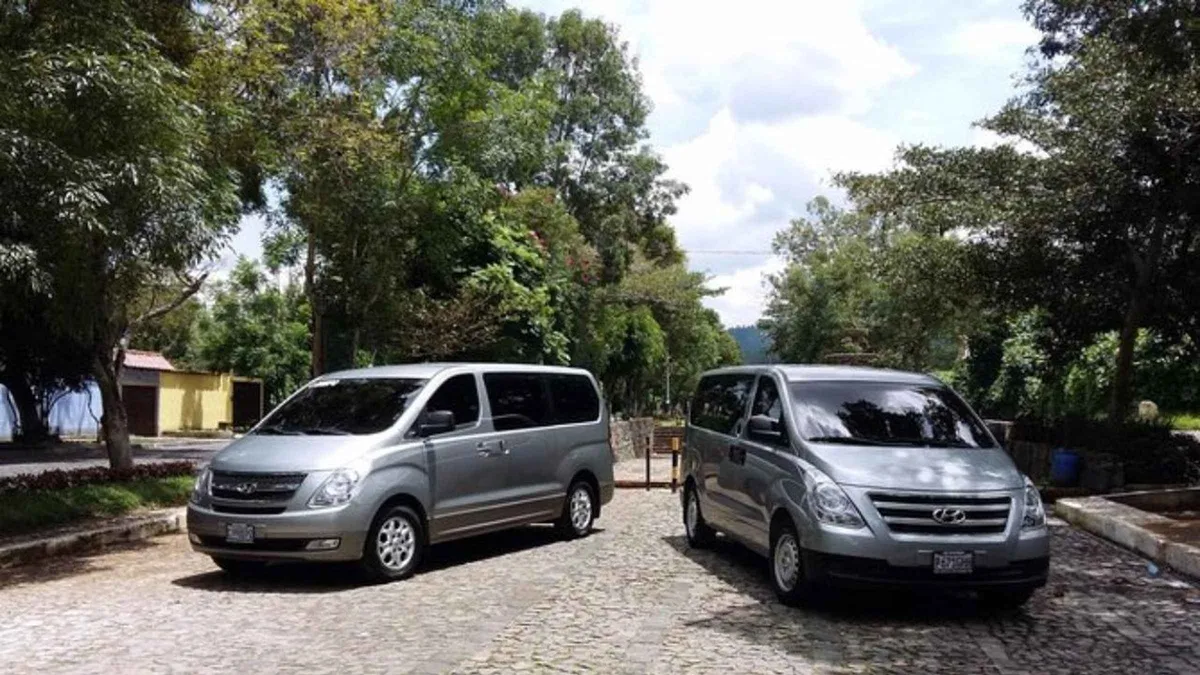
Guatemala City Airport: Private Transfer to Antigua
Private door-to-door transfer from La Aurora airport to your Antigua hotel, about an hour and a half.
Check Availability from $25
Antigua Guatemala: One-Way Shared Van Transfer to Panajachel
Direct shared van Antigua to Panajachel, the gateway town for Lake Atitlan; three hours, no changes.
Check Availability from $119
Chichicastenango and Iximché Day Trip from Antigua
Chichicastenango market plus the Iximche ruins in one loop; the day-trip with an archaeology bonus.
Check Availability from $120
Authentic experience in Monterrico. From Antigua
Monterrico black-sand beach and turtle bicheiro day pass from Antigua, transport and day pass included.
Check AvailabilityPrices, ratings and details are the platform's own. dollar figures are the listed prices — the platform bills in your account's currency.
Next
The airport page
The first run of every trip, every way priced
Chicken buses
The village network, its terminal and its advisory, in full
Day trips
Where the shuttles actually go, ranked and routed
Where to stay
The areas, measured in walking minutes
Getting Around Antigua Guatemala: Questions
Is Antigua Guatemala walkable?
Yes, and walking is the default way of getting around Antigua Guatemala. The UNESCO-listed colonial grid is flat and compact, and Parque Central is the measuring point for the whole plan. Rooms inside the Centro blocks sit an estimated 0 to 5 minutes from the park, the quiet 5a and 6a Avenida Sur band an estimated 8 to 15 minutes, and Jocotenango an estimated 25 to 35 minutes. The caveats are the cobblestones, which reward grip-soled shoes, and the altitude of about 1,530 m, which makes the midday sun stronger than the temperature suggests. The full breakdown with the walking anchors is in walking the grid.
How much is a tuk-tuk in Antigua Guatemala?
The municipal tariff is Q10 ($1.31) per ride within the city, set by the Municipalidad de La Antigua Guatemala. Tuk-tuks are not metered, so the fare only exists once you agree it. In practice drivers commonly ask visitors Q15 or more, and without a negotiation they can charge 50 to 100 percent above the tariff. The fix is the two-sentence script: name the destination, agree the price, then get in. Pay cash, and remember they come off the street around 22:00 and usually do not run to Guatemala City. The full story is in tuk-tuks.
Do you need a car in Antigua Guatemala?
No. Inside the grid, walking covers almost every pair of points in minutes. For the last mile there are tuk-tuks at the municipal Q10 ($1.31) tariff, and for every long run out of town Antigua is Guatemala's shuttle hub, with daily shared vans to the lake, the capital and the north. A rental car mostly buys you parking problems on narrow one-way streets inside a UNESCO perimeter. Rentals only make sense for specific rural plans, such as a multi-stop loop the shuttle timetable cannot serve. The one exception worth naming is Holy Week, when the municipal perimeter closes the center streets to traffic from early morning and a car becomes an object you park at Santa Ines and walk from. The long-run alternatives are compared in the shuttle hub.
Which shuttle do I take for the lake, and what does it cost?
By shared shuttle. Adrenalina runs Antigua to Panajachel for $25.00 (Q191) per person, daily at 08:00, 12:30 and 16:00, taking about 3 hours, door-to-door for center hotels only. The van to San Pedro La Laguna costs the same $25.00 (Q191), daily at 08:30 and 14:00, about 4 hours. Reserve 48 hours ahead on +502 5308 5106. For groups, a private Turansa van to Panajachel is $150 (Q1,146) per trip for up to 10 passengers. Both options are tabled in the shuttle hub, and the lake itself is covered in day trips.
Are there taxis and Uber in Antigua Guatemala?
Yes. The UK FCDO's frame for safer in-town transport is radio-dispatched taxis, which in Antigua are usually yellow, Uber where it is available, and taxis booked through your hotel. What does not exist is an official published taxi tariff, so the fare is whatever you agree or whatever the app sets. Ask your hotel desk what a run should cost before accepting a car, confirm the number with the driver, and prefer the app when you want the price fixed. The moments taxis win are night, rain, luggage and early airport runs. More in taxis and Uber.
Where do the chicken buses leave in Antigua?
From the lot behind El Mercado on the west side of town, north-west of 4a Calle Poniente and Alameda Santa Lucía. That lot, called La Terminal, handles the regional routes. The village runs to San Pedro, San Juan and Santa Ana do not follow fixed routes through town, so the reliable places to catch them are the Mercado itself or the corner at the Iglesia de Santa Lucía, roughly every 10 to 20 minutes. Buses to Guatemala City leave from the next street south of the artisan market, from about 05:30 every 4 to 5 minutes at Q15 ($1.96) cash. The full network is in chicken buses.
Moving Through Antigua on Film
Three verified films that show the movement this page prices: the walk, the buses and the wider transport system.
Antigua, Guatemala | 4K60fps | Walking Tour w/ Captions
The walking pace of the grid at ground level, exactly what the walking-times section on this page estimates.
Video: Backpack GringoHow to Get Around Guatemala: Complete Transportation Guide (2026)
The national transport picture, from shuttles to buses, with Antigua's hub role in context.
Video: Chris & GraceGuatemala Airport to Panajachel, Guatemala using Guatego bus
What a booked shuttle run out of Antigua actually looks like, seat by seat and road by road.
Video: Rochelle HewittVideos load from YouTube only when you press play.
We may earn a commission if you book through one of our links, at no extra cost to you. Full affiliate disclosure